Tack
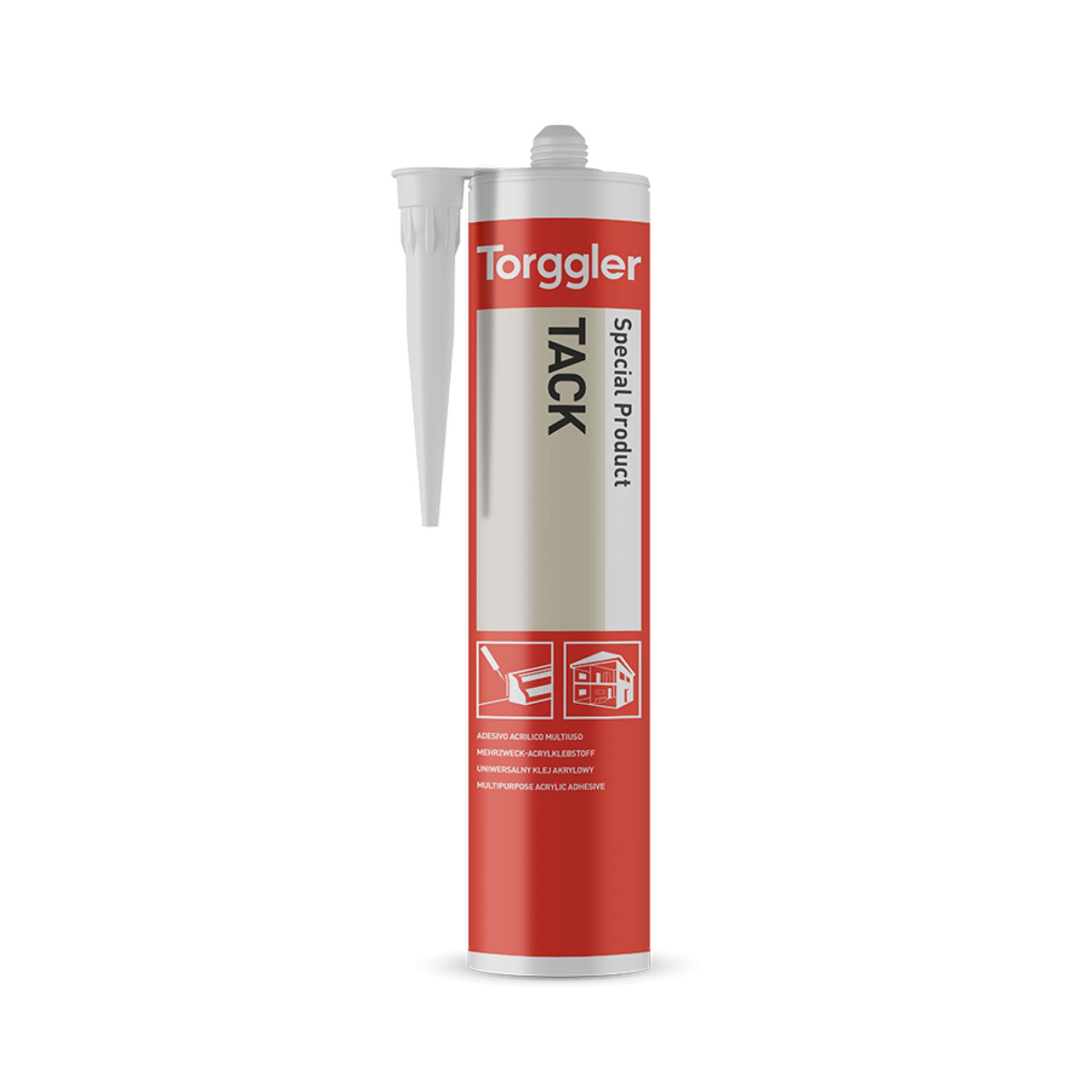
Multi-purpose acrylic adhesive for indoor use.


Multi-purpose acrylic adhesive for indoor use.

Discover more
Tack is a single-component adhesive for assembly, based on acrylic resins in an aqueous dispersion, and is therefore completely solvent-free. As the water evaporates, a compound with high adhesive strength is formed, which enables the permanent bonding of a wide variety of materials. At least one of the two substrates must be porous and absorbent (concrete, mortar, plaster or similar) to facilitate the evaporation of the water. Tack’s formulation guarantees excellent initial adhesion, good workability and exceptional long-term bond strength for the bonded materials.
Cleaning tools
Tools soiled with Tack should be cleaned with water whilst the adhesive is still fresh. If the sealant has
hardened, it can only be removed mechanically or using organic solvents (acetone, toluene).
Remove any excess adhesive with a damp cloth
Tack remains stable for at least 12 months provided it is kept in its original packaging and stored at a temperature above +5 °C
| Color | Code | Packaging | Packaging size | Pallet | Barcode |
|---|---|---|---|---|---|
| Ivory | 8154 | cartridge | 24x310 ml |
60 cardboards
|

|
Tack is used for bonding around the home, on both mineral and non-mineral substrates, and wherever there is a need to permanently bond two items, provided that at least one of the two substrates is porous and absorbent, thereby eliminating the need for mechanical fasteners (nails, screws) for most repairs or installations involving a wide variety of materials and items such as:
| PARAMETER AND TEST METHOD | VALUE |
| Density (ISO 1183-1) | 1.51 g/ml |
| Application temperature | from +5 °C to +40 °C |
| Surface curing time (MIT 45*) | approx. 60 minutes |
| Extrusion rate (MIT 30*) | 200 g |
| Consistency – flow tendency (ISO 7390) | 0.0 mm (thixotropic, does not run) |
| Operating temperature | from -25 °C to +85 °C |
| Shore A hardness (DIN 53505) | approx. 30 |
| Elongation at break (DIN 53504 – S3 die) | 720% |
| Tensile breaking load (DIN 53504 – S3 die) | 1.15 N/mm² |
| Modulus of elasticity at 100% (DIN 53504 – Die S3) | 1.02 N/mm² |
| Shear strength (UNI EN 1324 – initial) | 2.0 N/mm² |
| Shear strength (UNI EN 1324 – 70 °C) | 2.4 N/mm² |
| Shear strength (UNI EN 1324 – water) | not resistant |
| Resistance to dilute acids | excellent |
| Resistance to alkalis | good |
| Resistance to continuous contact with water | poor |
| Resistance to solvents | poor |
| Resistance to oils and fuels | poor |
* Torggler’s in-house methods are available on request.
Contact our team for personalized support and product guidance.