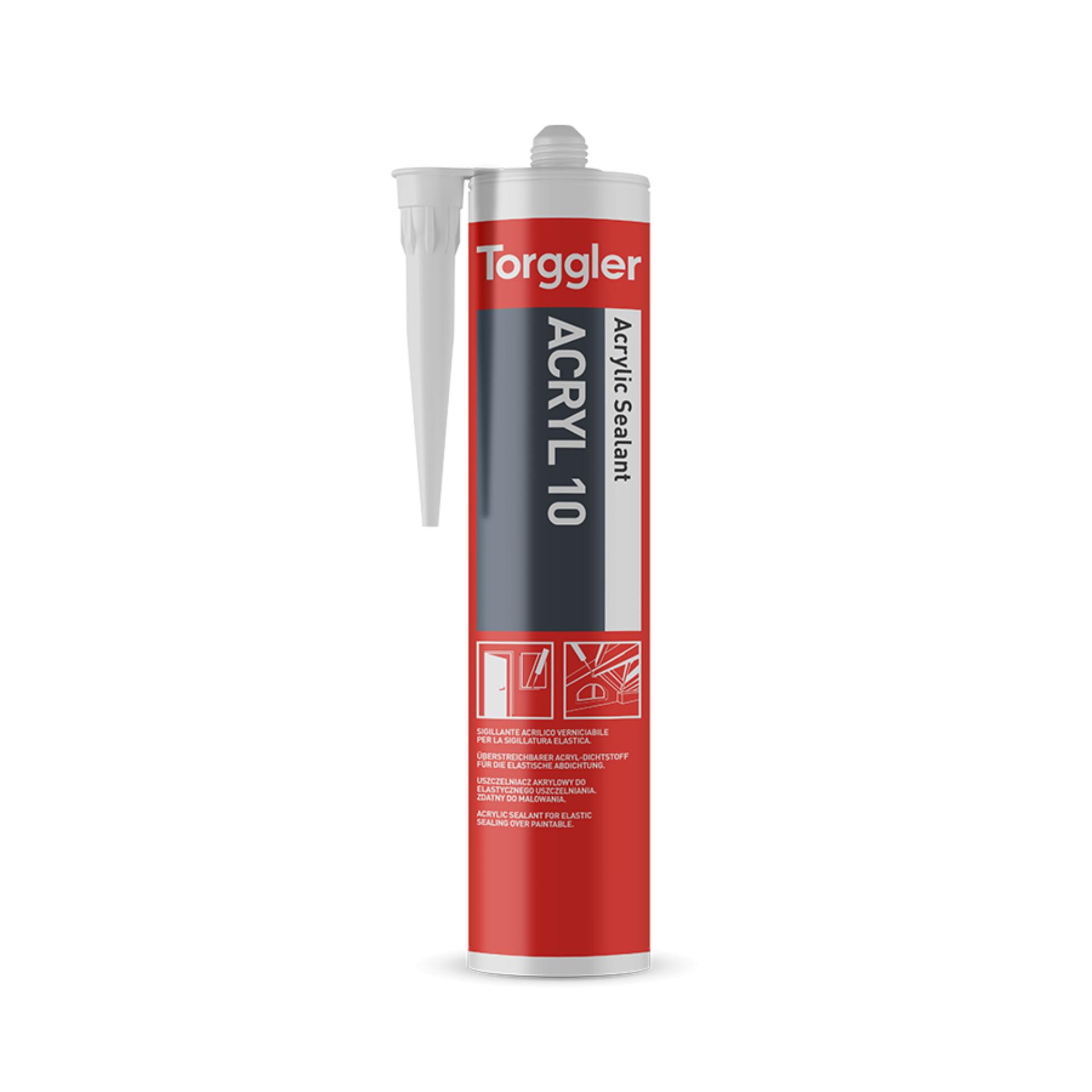
Acryl 10
Paintable acrylic sealant for the flexible sealing of connection joints.




Variations
Discover more
Acryl 10 is a single-component sealant based on acrylic polymers in an aqueous dispersion. It cures through the evaporation of water, forming an elastoplastic compound with excellent resistance to ageing. Acryl 10 adheres even to damp substrates. It is easy to apply, does not run and can be smoothed quickly. Application tools can be washed with water. It is ideal for sealing internal and external joints with a maximum expansion of 12.5 per cent. Outdoors, Acryl 10 is suitable for joints on vertical or horizontal surfaces, provided that water cannot accumulate. Acryl 10 is classified as a non-structural sealant for façade elements, for both external and internal use (type F-EXT/INT), in accordance with EN 15651-1. The white version of the product is certified as EC 1 Plus by GEV for its extremely low emissions of volatile organic compounds.
Cleaning tools
Tools soiled with Acryl 10 should be cleaned with water whilst the compound is still fresh. If the sealant has hardened, it can only be removed mechanically or using organic solvents (acetone, toluene).
When kept in its original, unopened packaging and stored at temperatures between +5 °C and +35 °C, Acryl 10 remains stable for at least 24 months. Cartridges that have not been completely emptied can be stored for approximately 3 months, provided they are tightly sealed. Do not expose to frost.
The material cures through the evaporation of water: the sealant loses its initial stickiness within 20–120 minutes, depending on environmental conditions. Low temperatures and/or high relative humidity slow down this process, whilst high temperatures and/or low relative humidity speed it up. Do not apply Acryl 10if rain is imminent: the applied sealant, which has not yet formed a film, may be washed away. Sealant that has not fully cured will be damaged by frost.
| Color | Code | Packaging | Packaging size | Pallet | Barcode |
|---|---|---|---|---|---|
| White | 6580 | cartridge | 24x310 ml |
60 cardboards
|

|
| Grey | 6578 | cartridge | 24x310 ml |
60 cardboards
|

|
Acryl 10 is suitable for the elastic sealing of joints between masonry and door and window frames, between roller shutter boxes and walls, between prefabricated walls and ceilings, between pipes passing through plaster and the plaster itself, for sealing cracks and crevices, and for the elastic sealing of curtain wall panels, etc. Acryl 10’s adhesion is particularly good on porous substrates such as concrete, mortar, brick and timber. Once dry, the product can be painted over.
| PARAMETER AND TEST METHOD | VALUE |
| Density (ISO 1183-1) | 1.67 g/ml |
| Application temperature | from +5 °C to +40 °C |
| Surface curing time (MIT 45*) | approx. 70 minutes |
| Full cure | after approx. 10 days (10×10 mm joint at 20 °C – 50% RH) |
| Resistance to driving rain | after approx. 4 hours |
| Operating temperature | from -25 °C to +85 °C |
| Shore A hardness (DIN 53505) | approx. 40 |
| Elongation at break (DIN 53504 – S3 die) | 670% |
| Tensile breaking load (DIN 53504 – S3 die) | 0.42 N/mm² |
| Modulus of elasticity at 100% (DIN 53504 – Die S3) | 0.40 N/mm² |
| Elongation at break (EN ISO 8339/A – Mortar backing – M1) | 350% |
| Tensile breaking load (EN ISO 8339/A – Mortar substrate – M1) | 0.10 N/mm² |
| Modulus of elasticity at 100% (EN ISO 8339/A – Mortar-bonded – M1) | 0.10 N/mm² |
| Maximum working elongation | 12.5% |
| Shrinkage | approx. 15% |
| Resistance to sagging | good |
| Resistance to dilute acids | good |
| Resistance to alkalis | good |
| Resistance to continuous contact with water | poor |
| Resistance to solvents | poor |
| Resistance to oils and fuels | poor |
| Paintability | can be painted with water-based paints |
* Torggler Internal Methods (MIT) are available on request.
| INDICATIVE CONSUMPTION TABLE | ||
| JOINT WIDTH × DEPTH (MM) | CONSUMPTION PER LINEAR METRE | LINEAR METRES COVERED BY ONE CARTRIDGE |
| 6×6 | 36 ml | 8.7 |
| 8×8 | 64 ml | 4.9 |
| 10×10 | 100 ml | 3.1 |
| 15×10 | 150 ml | 2.1 |
| 20×10 | 200 ml | 1.5 |
Contact our team for personalized support and product guidance.