Rocksolid M15
Fibre-reinforced concrete with high mechanical performance, suitable for the restoration and structural reinforcement of plasterwork – including reinforced plaster – and masonry.
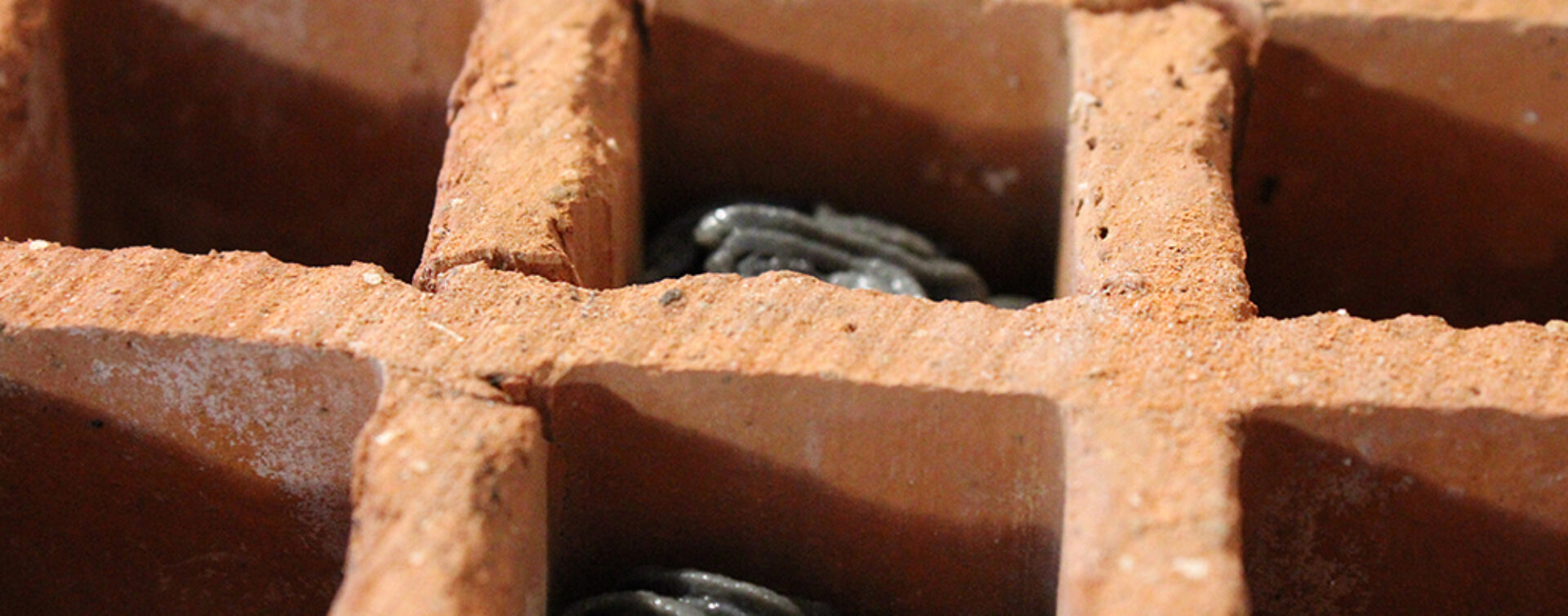
Fibre-reinforced concrete with high mechanical performance, suitable for the restoration and structural reinforcement of plasterwork – including reinforced plaster – and masonry.


Discover more
The substrate must be clean, sound and sufficiently rough. Remove, either by hand or using mechanical tools, all loose or non-adhering material, any existing plaster, dust, mould and any other substance that could compromise the product’s adhesion. High-pressure washing or sandblasting may be suitable for removing efflorescence, traces of oil, grease or other contaminants. The joints between the bricks must be properly filled. Any cavities, gaps or cracks in the masonry must be filled at least two days before application by means of repointing or ‘un-seam-and-seam’ repairs. Before application, dampen the substrate evenly to prevent it from absorbing too much mixing water, which could compromise the mortar’s performance. Remove any excess water before applying the product.
In the case of plaster or reinforced render, apply the metal or composite mesh after the first layer of plaster has been applied, securing it firmly to the existing masonry. The connectors must be compatible with the type of mesh used. For fibreglass mesh, compatible ‘L’-shaped connectors are recommended, at a rate of approximately 4–5 pieces per m², to be chemically fixed using Xtreme Grip Vinylester, a two-component vinyl ester resin-based anchor.
The two layers of plaster intended to embed the mesh must be applied wet-on-wet.
Product preparation
Rocksolid M15 must be prepared according to the chosen application method:
• Machine application: using a worm-gear plastering machine (such as the Turbosol) or a three-phase continuous-cycle mixing pump (such as the PFT G4), following the manufacturer’s instructions for setting the mixing and pumping parameters.
• Manual application: mix the product in a bowl-type concrete mixer, gradually adding clean water until a homogeneous, lump-free consistency is achieved.
• Small quantities: these can be mixed using a low-speed electric drill fitted with a whisk attachment to ensure even distribution of the binders and aggregates.
Use only the quantity of water specified in the technical data sheet. Avoid adding further water once mixing has begun, so as not to compromise performance.
Machine application
Mix Rocksolid M15 in a continuous-mix plastering machine, adjusting the water flow to approximately 320–340 l/h, until a homogeneous consistency is achieved. Use pumps suitable for the type of aggregate. Apply the product in layers up to 40 mm thick (minimum 10 mm), working from the bottom upwards. For greater thicknesses, apply in several coats, leaving the previous coat unfinished. After a few minutes, level the surface and finish it with a trowel (plastic, wooden or sponge), depending on the desired effect. Avoid application on surfaces that are too hot or exposed to the wind. In the event of high temperatures or low humidity, protect the surface or mist it with water for the first 24–36 hours.
Manual application
Mix Rocksolid M15 with approximately 16 per cent clean water (equivalent to 4–4.25 litres of water per 25 kg bag) in a bowl-type concrete mixer, using a mechanical agitator (low-speed drill with a suitable mixing paddle) until the mixture is homogeneous and free from lumps. Apply with a trowel in 20 mm layers. For filling gaps or repairing joints, spread the mortar at the base and insert the masonry units with light pressure. For exposed joints, apply a layer at least 2 cm thick and clean with water and a sponge float before the mortar sets. In the case of ‘exposed’ masonry, remove any excess product with water and a sponge float.
Finishing
Before applying any further skim coats or finishes, allow the plaster to cure completely: approximately 7 days per centimetre of thickness. If no decorative finish is required, in the case of surfaces exposed to the elements, the plaster can be protected with Promural Silicon, a ready-to-use, transparent, vapour-permeable water-repellent impregnating agent based on siloxane polymers dissolved in solvent.
Cleaning
Tools used for application can be cleaned with water before the mortar sets; thereafter, cleaning can only be carried out by mechanical removal.
6 months in a cool, dry place with the packaging intact
| Code | Packaging | Packaging size | Pallet | Barcode |
|---|---|---|---|---|
| 8394 * | bag | 25kg |
50 bags
|

|
| Texture | powder |
| Colour | grey |
| Mixing ratio | Approximately 16–17 litres of water per 100 kg of product |
| Particle size | 0–3 mm |
| Adhesion | 1 N/mm² FP:B |
| Reaction to fire | Euroclass A1 |
| Compressive strength | > 15 N/mm² |
| Compressive modulus of elasticity (EN 13412) | 12,000 N/mm² |
| Class | GP – CSIV – W0 for 998-1 and M15 for 998-2 |
| Thermal conductivity (λ) | 1.11 W/mK (tabulated value P=50%) |
| Water vapour permeability (μ) | 15/35 |
| Apparent bulk density | 1550 kg/m³ |
| Operating temperature | +6°C / +35°C |
| Packaging | 25 kg bags – 1250 kg pallets |
15 kg/m² per centimetre of thickness
Contact our team for personalized support and product guidance.