High Tack
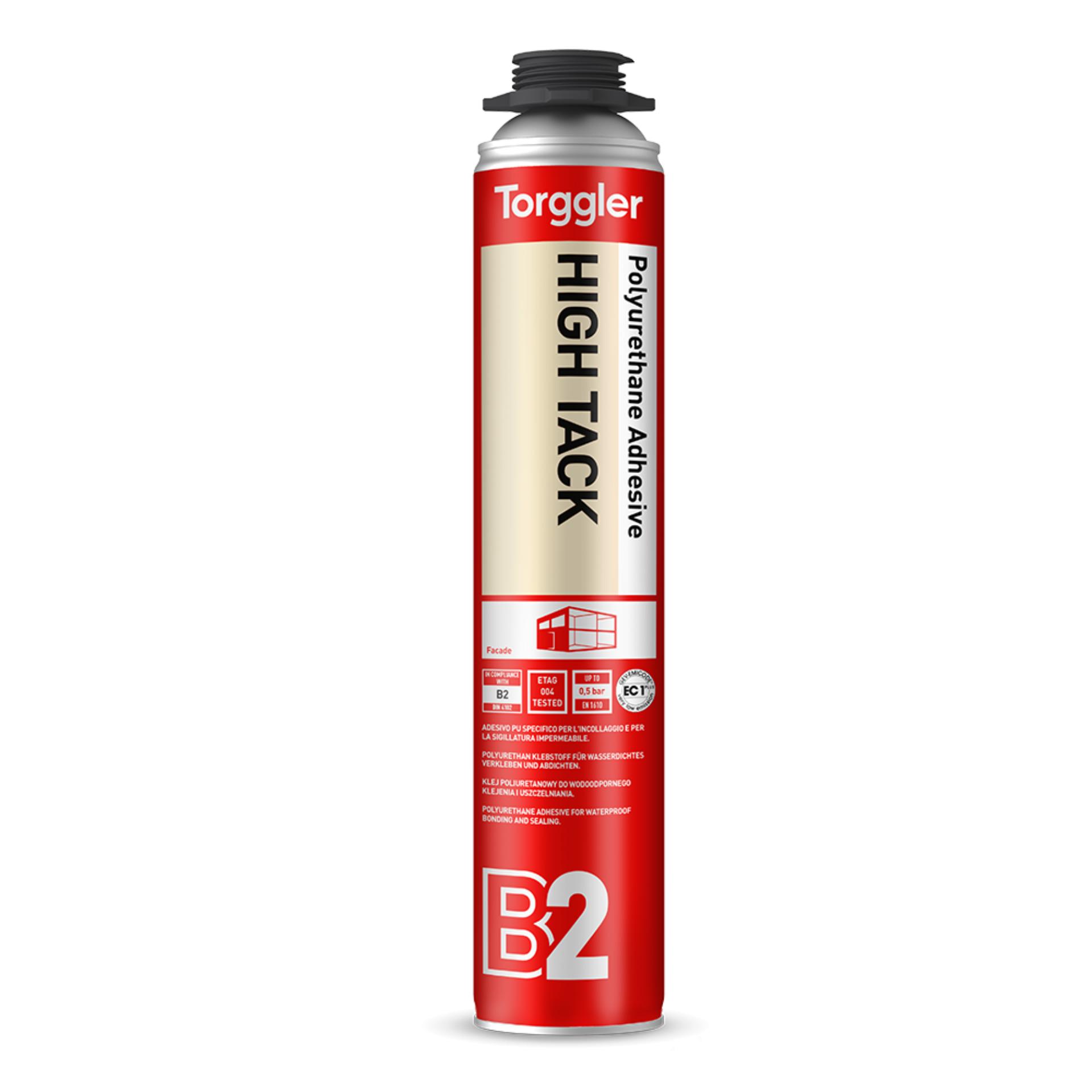
A single-component polyurethane adhesive specifically designed for bonding and waterproof sealing.
A single-component polyurethane adhesive specifically designed for bonding and waterproof sealing.
A single-component polyurethane adhesive specifically designed for bonding and waterproof sealing.




Application areas
Discover more
High Tack is a single-component, waterproof and high-tack polyurethane adhesive. It bonds strongly to wood, brick, concrete, aerated concrete, fibre cement, metal, glass, EPS, XPS, PU, rock wool, glass wool, polymeric materials and plastics, with the exception of polyethylene, Teflon and silicone. The formulation has been specifically developed to ensure controlled post-expansion: the increase in volume (visible only when the product is not immediately compressed after extrusion) is minimised to increase density and, consequently, adhesive strength and tear resistance, thus enabling a wide range of applications for ‘High Tack’ as an adhesive. Should the cured product protrude from the application surface or cavity, it can be cut, drilled, sanded, painted or plastered. It offers good resistance to water, detergents, microorganisms and chemicals. The high viscosity and adhesiveness of the fresh product, the dimensional stability and mechanical properties of the cured material, make ‘High Tack’ the ideal product for bonding applications, particularly in confined spaces where the weight of the assembled components prevents expansion, thereby contributing to the formation of a compact and continuous polyurethane adhesive layer.
1. The substrates to be bonded must not only be adequately cured and free from significant shrinkage, but must also be sufficiently strong, sound, clean and free from oils, greases, paint film residues, dust and general dirt that could impair adhesion: if necessary, remove any loose material and carry out a general clean. Moisten the surface before application to ensure the fresh product has the necessary moisture for proper curing.
2. Remove the protective cap from the nozzle and screw it onto the appropriate spray gun (Torggler S.r.l. type T2000 or T500)
3. Shake the can for at least 15 seconds before use and repeat this step after any breaks in work.
4.1 LAYING GRINDED BLOCKS FOR NON-LOAD-BEARING WALLS
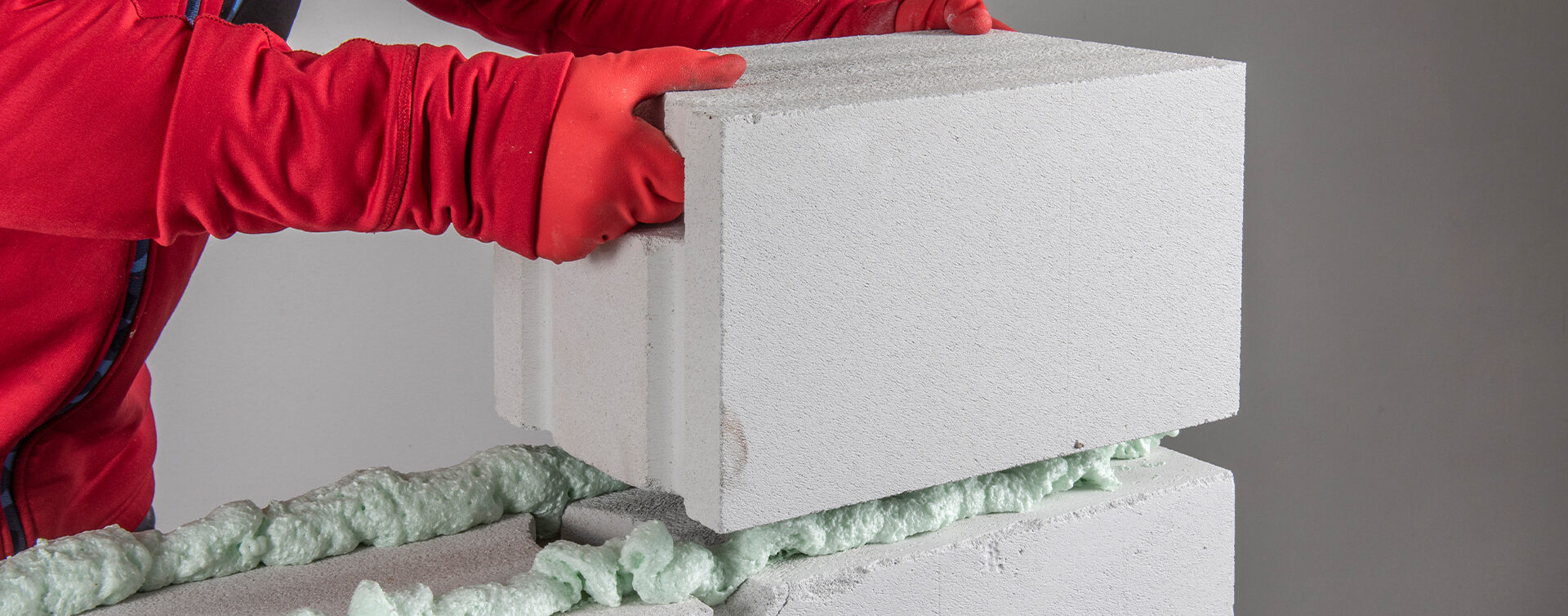
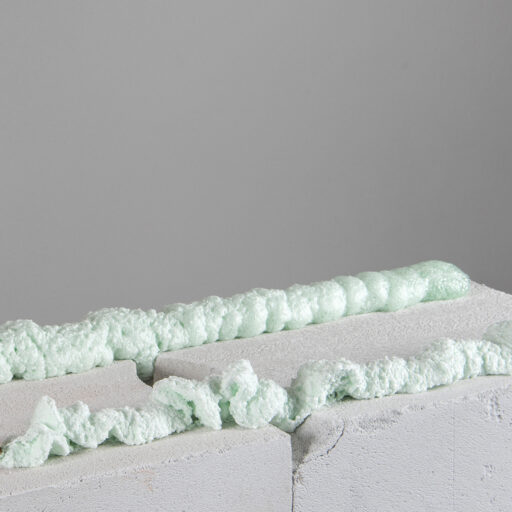
Prepare the installation base by creating a level bed of mortar, levelling and smoothing it, and checking that it is perfectly horizontal using a spirit level; if required by the specifications, also provide a tar paper membrane to prevent any capillary rise of damp. Turn the cylinder upside down so that the valve is facing downwards, point the nozzle of the gun in the desired direction and press the trigger, forming beads approximately 3 cm in diameter for bonding rectified clay blocks (perforated), and of approximately 1.5 cm for bonding rectified aerated and autoclaved cellular concrete blocks. In the case of partition and infill wall elements with thicknesses of approximately 10–12 cm, a single bead positioned at the centreline of the row of blocks will suffice; for thicker masonry, but still in the case of non-load-bearing infill walls, it will be necessary to create two parallel beads, positioned at a distance of approximately 5 cm from the edge. Then lay the next course of blocks before a surface film forms on the adhesive and repeat the process for all the courses required to complete the wall to the required height. A wall built using this technique is uniform and continuous, thereby avoiding the risk of thermal and acoustic bridges. In addition to the speed of installation, the system reduces waiting times due to the fact that ‘High Tack’ does not introduce moisture into the masonry – an issue that is, in contrast, very evident with mortar-based installation – and due to the rapid drying of the polyurethane adhesive itself; these technical aspects make it possible to proceed with the subsequent stages of work in a very short space of time.
4.2 BONDING THERMAL INSULATION PANELS
Turn the can upside down so that the valve is facing downwards, point the gun nozzle in the desired direction and press the trigger to apply the adhesive to the back of the panel, forming a perimeter bead approximately 3 cm from the edge and 2–3 cm thick. Apply a bead of the same dimensions in the centre, in a W-shape, and wait a few minutes: this waiting period is necessary to prevent the product’s post-expansion – however limited – from causing significant misalignment between the installed panels. It is advisable to carry out a test to check the actual film-forming time of High Tack, on-site, to prevent a hardened surface film from forming, which would render it non-adhesive. Position the panel on the wall and align it with the surrounding panels, pressing it firmly into place and using a fixed support to prevent the panel from slipping. After 2 hours, proceed with mechanical fixings. The same installation technique can be used, with the necessary adaptations as required, for the installation of both insulated and non-insulated plasterboard sheets.
4.3 SEALING/BONDING OF PLUMBING FITTINGS
Position the first base element. Turn the cylinder upside down so that the valve is facing downwards, point the nozzle of the gun in the desired direction and press the trigger, creating a bead approximately 3 cm in diameter along the entire upper edge with an interlocking profile. Position the next riser within a few minutes and repeat the process for all the elements, risers and/or covers to be installed, until the work is complete. The compression of the bead, achieved by the weight of the overlapping/adjacent elements, will create a sealing system capable of ensuring watertightness, even under pressure, up to values of around 0.5 bar. In the case of pipe connections and fittings in manholes/tanks, after positioning the pipe or duct by fitting it into the designated cavity of the manhole or tank, form a ring of adhesive approximately 3 cm in diameter around the joint itself, filling the gap between the two elements to be joined by approximately 50 per cent of the available space. The subsequent post-expansion of the adhesive will completely fill the gaps; however, given the substantial thickness of the seal, whilst it will ensure good watertightness, it will not provide an effective pressure seal. Once a surface film has formed, any excess adhesive can be compressed with your fingers – wearing suitable gloves – to form a more compact bead.
5. The adhesive will be fully cured approximately one hour after application. After this time, any excess material can be cut away with a craft knife or smoothed down with sandpaper.
The final curing, and therefore the entry into service of the bonded elements, can take place approximately 24 hours after application.
6. If the entire contents of a cylinder are not used, return it to an upright position and press the trigger for a few moments. The escaping gas will clean the valve and the gun.
Cleaning
Traces of uncured product, for example on clothing, tools, etc., can be cleaned with polyurethane foam solvent. Cured adhesive can only be removed mechanically (by scraping or sanding).
Store in a cool place in an upright position. Take great care to avoid storing the product horizontally, as this causes deposits to form rapidly beneath the valve, which will irreparably compromise the extrusion of the material. High Tack’ has a shelf life of at least 18 months if stored upright, in a cool place (at temperatures below 25 °C), in a dry place and in its original, unopened packaging. Observe the expiry date indicated on the can.
The yield of the adhesive depends heavily on the application conditions (the temperature of the cylinder, the substrate and the ambient temperature). At low temperatures, the pressure at which the fresh material emerges from the valve is reduced; to achieve good output, it is recommended that the cylinder be stored at a temperature of approximately 20 °C.
Do not use the product:
Substrates and materials completely saturated with water will prevent adhesion.
The High Tack. canister is a pressurised container. Protect from direct sunlight and do not expose to temperatures exceeding 50 °C. Do not pierce or burn, even after use. Do not spray onto a flame or any incandescent object. Keep away from all sources of ignition, flames and sparks. Do not smoke. Do not breathe in the aerosols. Keep out of the reach of children. This product contains highly flammable components; therefore, use it only in well-ventilated areas. Particularly when using several cylinders in the same location, there is a risk of explosive air/propellant gas mixtures forming. Contains 4,4'-diphenylmethane diisocyanate (EEC No. 615-005-00-9). Harmful if inhaled. Irritating to the eyes, respiratory tract and skin. May cause sensitisation by inhalation and skin contact. In case of contact with the eyes, rinse immediately with plenty of water and seek medical advice. In case of skin contact, wash immediately and thoroughly with soap and water. Wear suitable protective clothing and gloves. In case of inadequate ventilation, use a suitable respirator. In the event of an accident or if you feel unwell, seek medical advice immediately (if possible, show the label to the doctor).
| Color | Code | Application | Packaging | Packaging size | Pallet | Barcode |
|---|---|---|---|---|---|---|
| Light blue | 5337 | Gun application | can | 12x750 ml |
42 cardboards
|

|
| PARAMETER AND TEST METHOD | VALUE |
| Ambient temperature during application | From -5 °C to +40 °C |
| Operating temperature | From -40 °C to +120 °C |
| Surface film formation at 23°C and 50% RH (MIT 87*) | 7–10 minutes |
| Cutting time for a 20 mm diameter cord at 23 °C and 50% RH (MIT R/8*) | 30–40 minutes |
| Density after controlled expansion (MIT 50*) | 13 – 18 kg/m³ |
| Dimensional variation at 23 °C and 50% RH (MIT 52*) | <3% |
| Fire behaviour (DIN 4102) | B2 |
| Linear yield (cord Ø 3 cm) (MIT 119*) | 40–50 metres |
| Adhesion to polystyrene (ETAG 004) | 0.2 N/mm² (panel failure) |
| Waterproofing/pressure resistance (UNI EN 1610) | 0.5 bar (Method W) |
| UV resistance | poor, tends to yellow |
* Torggler’s in-house test methods are available on request.
The amount of High Tack used depends on the type of materials to be bonded and the installation method. As a rough guide, one can of High Tack is sufficient to install between 5 and 10 m² of curtain walling using rectified blocks, or to bond between 8 and 12 m² of insulation panels.
Contact our team for personalized support and product guidance.