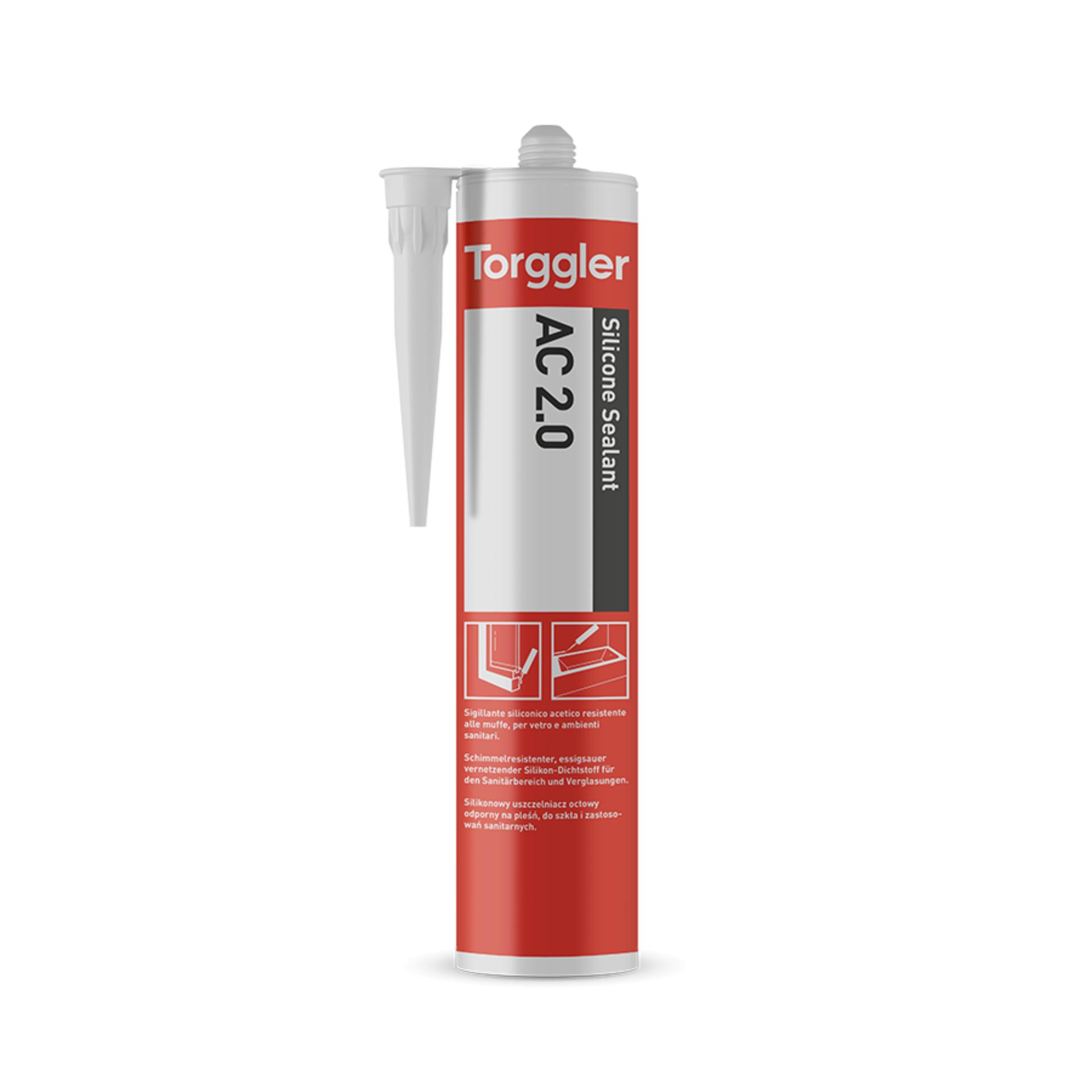
AC 2.0
Multi-purpose silicone sealant with acetic curing.




Variations
Discover more
The joint surfaces must be dry, sound, clean, free of grease and firm. The seal must be at least 6 x 6 mm in size. For widths exceeding 1 cm, the ratio of width to depth must be 2:1. Insert the sealing cord to ensure the correct proportions of the seal and to prevent it from adhering to the bottom of the joint. In the case of substrates of uncertain nature, check the adhesion of ‘AC 2.0’ with preliminary tests or apply ‘Primer Silicone’. In the case of metal substrates, carry out preliminary tests to ensure there is no risk of corrosion. Protect the edges of the joint with self-adhesive paper tape. Cut the nozzle to a diameter proportional to the dimensions of the joint. Inject a generous amount of ‘AC 2.0’. Smooth it out with a spatula moistened with ‘Smooth’ before a skin forms on the surface. Apply firm pressure to ensure the joint is filled without voids and that the sealant adheres fully to the sides of the joint. Remove the protective tape immediately and smooth the surface again with a hand moistened with ‘Smooth’.
Store in a cool, dry place. When kept in its original packaging, it will keep for at least 24 months
| Color | Code | Packaging | Packaging size | Pallet | Barcode |
|---|---|---|---|---|---|
| Transparent | 8030 | cartridge | 24x280 ml |
60 cardboards
|

|
| White 9010 | 8031 | cartridge | 24x280 ml |
60 cardboards
|

|
For creating joints between building elements, both vertical and horizontal, indoors and outdoors, and in damp environments. For the elastic bonding of various non-porous materials in general industrial applications. Once cured, it offers high resistance to UV rays, weathering, standing water, extreme temperatures, microbial growth and ageing. Excellent adhesion to smooth, non-absorbent substrates: glass, ceramic tiles, glazed surfaces, rigid plastics, anodised aluminium and certain metals. It does not crumble, does not shrink from its initial volume and retains its elasticity even at low temperatures without placing stress on the joint edges.
| TEST PARAMETER AND METHOD | VALUE |
| Density (UNI 8490 – Part 2^) | 0.969 g/ml |
| Extrusion rate (MIT 30) | 66.6 g |
| Application temperature | from +5 °C to +40 °C |
| Surface curing time (MIT 33) | 20 minutes |
| Curing rate (23 °C – 50% RH) | 1.5 mm / 24 hours 4.0 mm / 72 hours |
| Operating temperature | -50 °C to +180 °C |
| Shore A surface hardness | 23 ± 3 |
| Elongation at break (ISO 37) | 800 % |
| Tensile strength (ISO 37) | 1.7 N/mm² |
| Modulus of elasticity at 100% (ISO 37) | 0.25 N/mm² |
| Elongation at break (UNI EN ISO 8339/A – G) | 200 % |
| Tensile strength (UNI EN ISO 8339/A – G) | 0.65 N/mm² |
| Modulus of elasticity at 100% (UNI EN ISO 8339/A – G) | 0.37 N/mm² |
| Tear strength (ISO 34 Method C) | 4.5 N/mm² |
| Maximum working elongation (ISO 11600) | 25 % |
| Elastic recovery | > 90 % |
| Acid resistance | excellent |
| Alkali resistance | Excellent |
| Odour after cross-linking | none |
| Colour | Transparent, white and grey |
Approximate yield in linear metres of a sealant cartridge = V / (L x P).
V = Cartridge content in ml
L = Sealing width in mm
P = Sealing depth in mm
Contact our team for personalized support and product guidance.