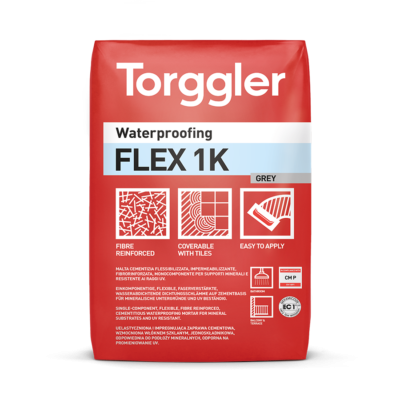
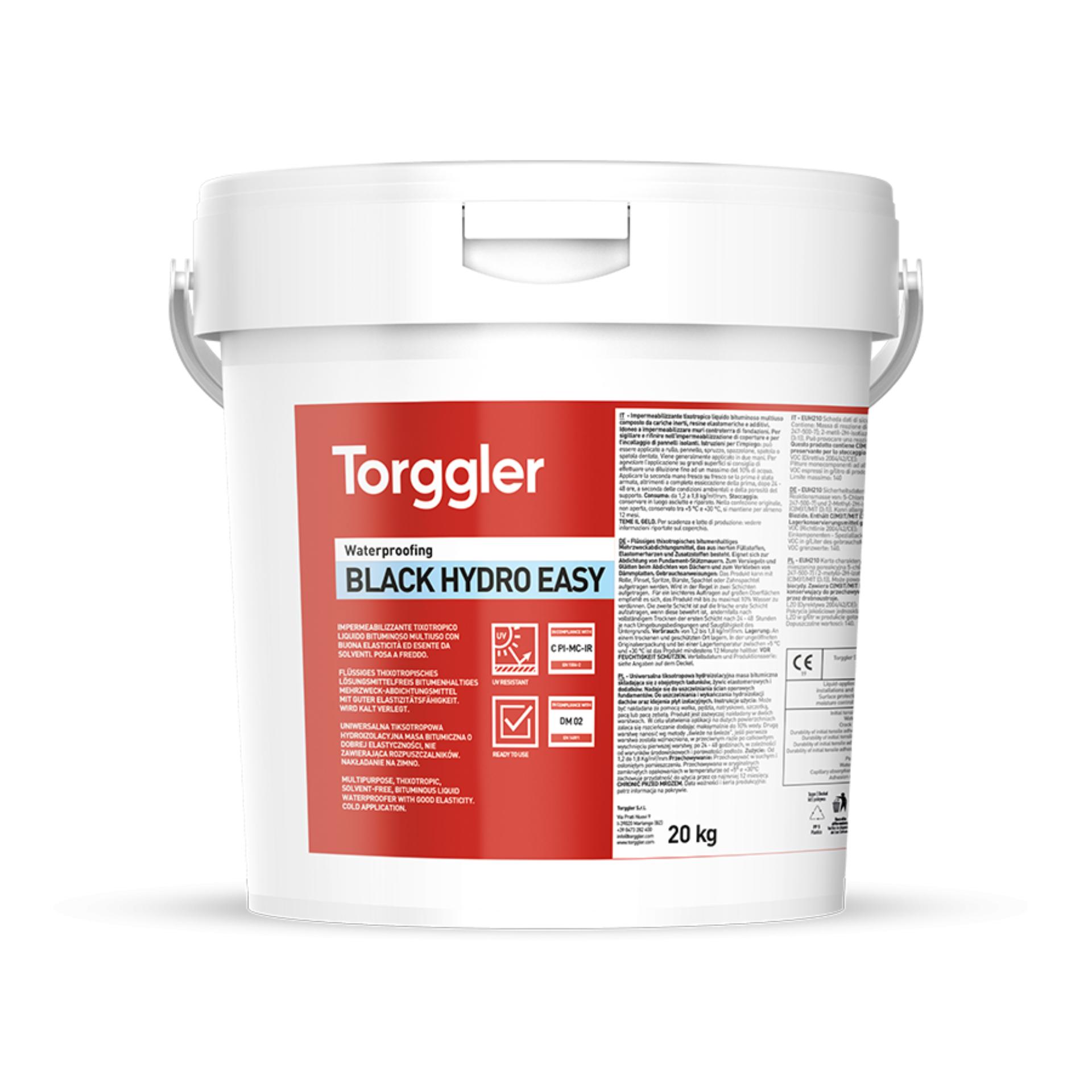
Black Hydro Easy
Multi-purpose, thixotropic, liquid bituminous waterproofing compound for surface protection systems for concrete, classified as Type C in accordance with UNI EN 1504-2, principles PI, MC and IR.
Multi-purpose, thixotropic, liquid bituminous waterproofing compound for surface protection systems for concrete, classified as Type C in accordance with UNI EN 1504-2, principles PI, MC and IR.


Application areas
Discover more
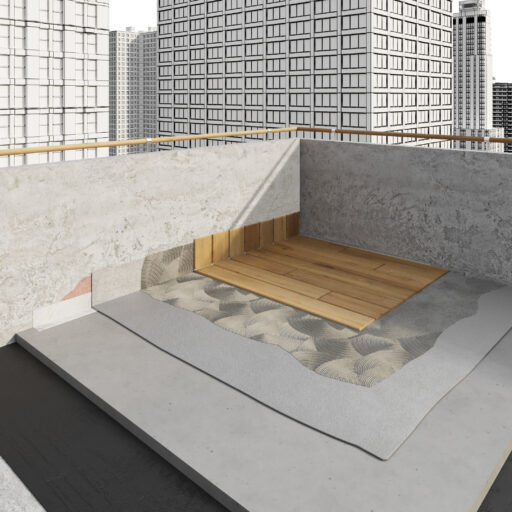
Black Hydro Easy is a multi-purpose, thixotropic, liquid bituminous waterproofing compound consisting of inert fillers, elastomeric resins and special additives. Suitable for waterproofing foundation walls in contact with the ground, for sealing and finishing in roof waterproofing, and for bonding insulation panels.
Black Hydro Easy is a surface protection coating in accordance with EN 1504-2, Type C, and complies with principles 1.3 (protection against ingress), 2.2 (moisture control) and 8.2 (increased resistivity) in accordance with EN 1504-9, and is classified under UNI EN 14891 as class DM O2.
Preparation for application
Substrate surfaces must be sound and dry, clean and free from release agents, dust, loose or non-adhering material and general dirt, with no paint film residues. Stir before use.
Application instructions
‘Black Hydro Easy’ can be applied using a roller, brush, spray, wide-bristle brush, trowel or notched trowel, and it is advisable to apply two coats. To facilitate application on large surfaces, it is recommended to dilute the product with up to 10 per cent water. Apply the second coat wet-on-wet if the first coat has been primed; otherwise, apply once the first coat is completely dry, after 24–48 hours, depending on environmental conditions and the porosity of the substrate.
Cleaning
Clean the tools used with water immediately after use. You may try to remove dried product with hot water; otherwise, it must be removed using standard synthetic thinners.
Black Hydro Easy remains stable for at least 24 months if kept in its original packaging and stored at temperatures between +5 °C and +30 °C. DO NOT FREEZE.
| Color | Code | Packaging | Packaging size | Pallet | Barcode |
|---|---|---|---|---|---|
| Black | 8122 | bucket | 5kg |
80 buckets
|

|
| Black | 8068 | bucket | 20kg |
33 buckets
|

|
Black Hydro Easy can be used as:
| Appearance: | Thixotropic paste |
| Colour: | Black |
| Application temperature: | +5 °C to +35 °C |
| Dry residue at 130 °C (EN ISO 3251): | 53–59% |
| Brookfield viscosity at +20 °C (impeller 6; 10 rpm) (EN ISO 3219): | 700 ± 140 P |
| Specific gravity at +20 °C (EN ISO 2811-1): | 1.21 ± 0.04 kg/l |
| Low-temperature flexibility (EN 15813): | -30 °C |
| Dimensional stability at high temperatures (EN 15818): | +150 °C |
| Touch-dry time: | 4 hours |
| Recoating time: | 24/48 hours * Note: values recorded at +23 °C and 50% RH. The value may vary depending on the thickness of the applied product and specific site conditions: temperature, humidity, ventilation and absorbency of the substrate. |
| PERFORMANCE CHARACTERISTICS (EN 1504-2:2004 – C COATINGS – PI MC IR) | |
| CO₂ permeability (EN 1062-6): | Sd > 50 m |
| Water vapour permeability (EN ISO 7783): | Class I – Sd < 5 m |
| Capillary absorption and water permeability (EN 1062-3): | w < 0.1 kg/m²*h⁰.⁵ |
| Direct tensile adhesion test (EN 1542): | > 1 N/mm² |
| CLASSIFICATION IN ACCORDANCE WITH UNI EN 14891 CLASS DM O2 | |
| Initial tensile adhesion | > 0.5 N/mm² |
| Tensile adhesion after immersion in water | > 0.5 N/mm² |
| Tensile adhesion after thermal ageing | > 0.5 N/mm² |
| Tensile adhesion after freeze-thaw cycles | > 0.5 N/mm² |
| Tensile adhesion after contact with lime-saturated water | > 0.5 N/mm² |
| Water impermeability | Waterproof |
| Crack-bridging ability (at -20 °C) | > 0.75 mm |
The consumption of Black Hydro Easy varies depending on the substrate and the desired thickness.
• On average, to achieve a dried film thickness of 1 mm, the quantity of product used is approximately 1.5 kg/m².
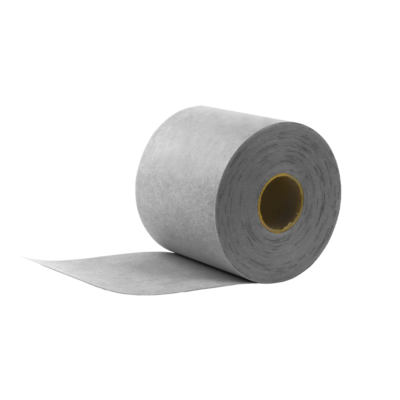
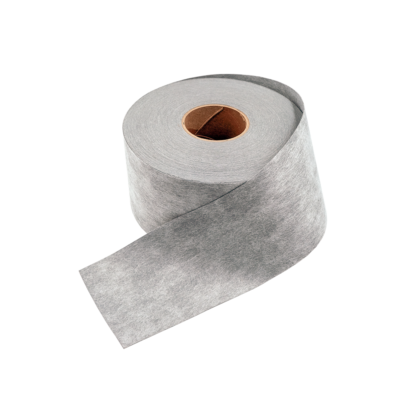
• When applied with a reinforcing fabric such as NT 50, the total consumption is 2 kg/m².
• For spot-bonding of insulation boards, consumption is approximately 400–700 g/m².
Contact our team for personalized support and product guidance.