Tile 600 is a grey-coloured cementitious powder adhesive, based on a special blend of high-strength, fast-setting and fast-hardening cements, selected aggregates, synthetic resins and specific additives, specially formulated for the installation of ceramic tiles over existing surfaces. Once mixed with water, it produces an adhesive with excellent workability, good flexibility and high adhesion on all types of substrates, particularly on old ceramic or natural stone floors and wall coverings. The rapid development of initial mechanical strength ensures, under normal curing conditions, that the surface is walkable approximately 4 hours after application. The extended open time allows for safe installation even in hot and draughty conditions. It is resistant to freeze-thaw cycles.
Tile 600 is classified as a Class C2 FE cementitious adhesive in accordance with EN 12004.
Instructions for use
Preparation for installation
Substrates must be sufficiently dry, strong, sound and even, clean and in good condition, free from oil, grease, dust, loose material and general dirt, and free from paint film residues; they must also be adequately cured and free from significant shrinkage. As a general guide, traditional cement screeds with normal setting and hardening times must have been cured for at least 28 days; cement or mixed-mortar plasters must be allowed to dry for at least 14 days. Major surface imperfections and irregularities, such as unevenness, cavities, gravel pockets, eroded or deteriorated areas, must be repaired and levelled beforehand using self-levelling compounds, such as Livellina 0-10 or Livellina 5-30, or a suitable mortar, such as Multimix Evo, ACS Restauro, ACS Rinnova or ACS Monorasante. Substrates that are particularly porous or crumbly, and those with very low mechanical strength that are easily scratched, must first be treated with Tile Primer or Multigrip.
Product preparation
Mix ‘Tile 600’ with 28–30% clean water (equivalent to 7.0–7.5 litres per 25 kg bag) as follows: pour almost all the required mixing water into a suitable container, then slowly add the powdered product, simultaneously stirring the mixture as it forms using a low-speed drill with a suitable mixing paddle. Once all the powder has been added, pour in the remaining water and mix until the mixture is homogeneous and free of lumps, taking particular care to remove any lumps of unmixed material from the sides and bottom of the container. Leave to rest for about 5 minutes, then stir briefly. The adhesive prepared in this way remains workable in the mixing container for approximately 45 minutes under normal conditions (at 20 °C); higher temperatures shorten the workability time, whilst lower temperatures extend it.
Installation instructions
In the event of direct sunlight, and consequently high substrate temperatures, it is advisable to dampen the substrate with a sponge to cool it down, without leaving any surface water.
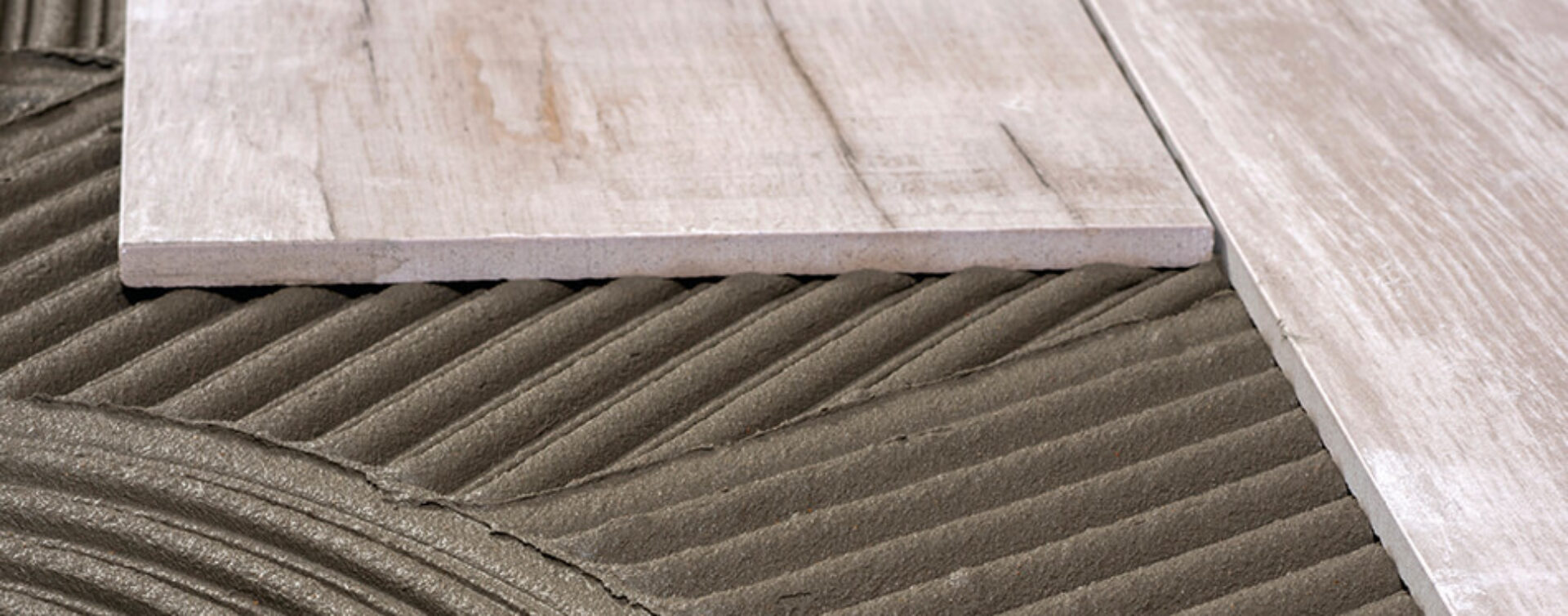
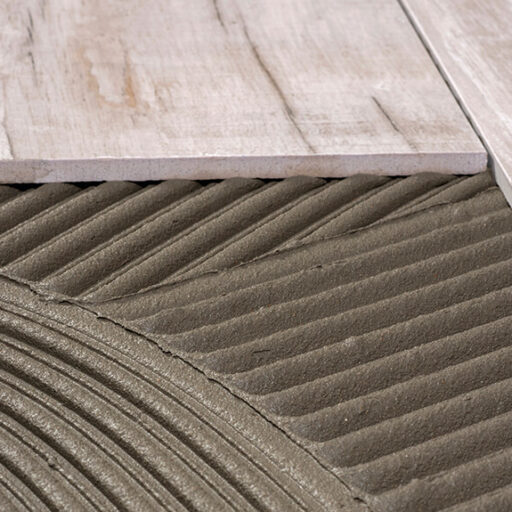
Apply the adhesive using a suitable notched trowel, the size of which will depend on the type and size of the tiles to be laid, ensuring that the entire back of the tiles is covered. For better adhesion, it is recommended to first spread a thin, even layer of adhesive onto the substrate using the smooth side of the notched trowel, and then immediately apply a second layer of the desired thickness using the notched side. Apply the tiles by exerting adequate pressure and applying a slight translational movement to them. When bonding tiles with a pronounced profile on the underside, for external applications—especially in areas subject to significant temperature fluctuations or freeze-thaw cycles—it is necessary to use the ‘buttering-floating’ technique: the mixed adhesive is spread onto the substrate using a notched trowel and then applied to the back of the tile with a trowel, levelling it flush with the ridges. Provided that a sufficient quantity of adhesive has been applied, this ensures adhesive-to-tile contact across the entire bonding surface (an essential condition for the installation of floor and wall coverings exposed to freeze-thaw cycles and significant water stress). The tiles must be laid only within the time window during which the applied adhesive is still fresh and tacky, i.e. it has not yet formed a surface skin. This time window is called the adhesive’s ‘open time’ and depends on environmental conditions. Tile 600’s open time is greater than 30 minutes at 23 °C and 50% RH. High temperatures, direct sunlight and strong ventilation, as well as a highly porous and absorbent substrate, can significantly reduce the open time, whilst low temperatures, high ambient humidity and non-absorbent substrates are favourable conditions for achieving a longer open time. If the open time has elapsed and the applied adhesive has formed a surface skin, it is necessary to go over it again with a notched trowel to break the skin and ‘refresh’ it. Under no circumstances should the surface be wetted, as this would form a non-adhesive film of water that prevents the tiles from bonding to the adhesive, irreparably compromising the installation. Tiles should not normally be wet before installation; only in the case of tiles with a dusty underside is it advisable to wash them by immersing them for a few seconds in clean water. For plaster substrates, pre-treatment with Tile Primer is absolutely essential.