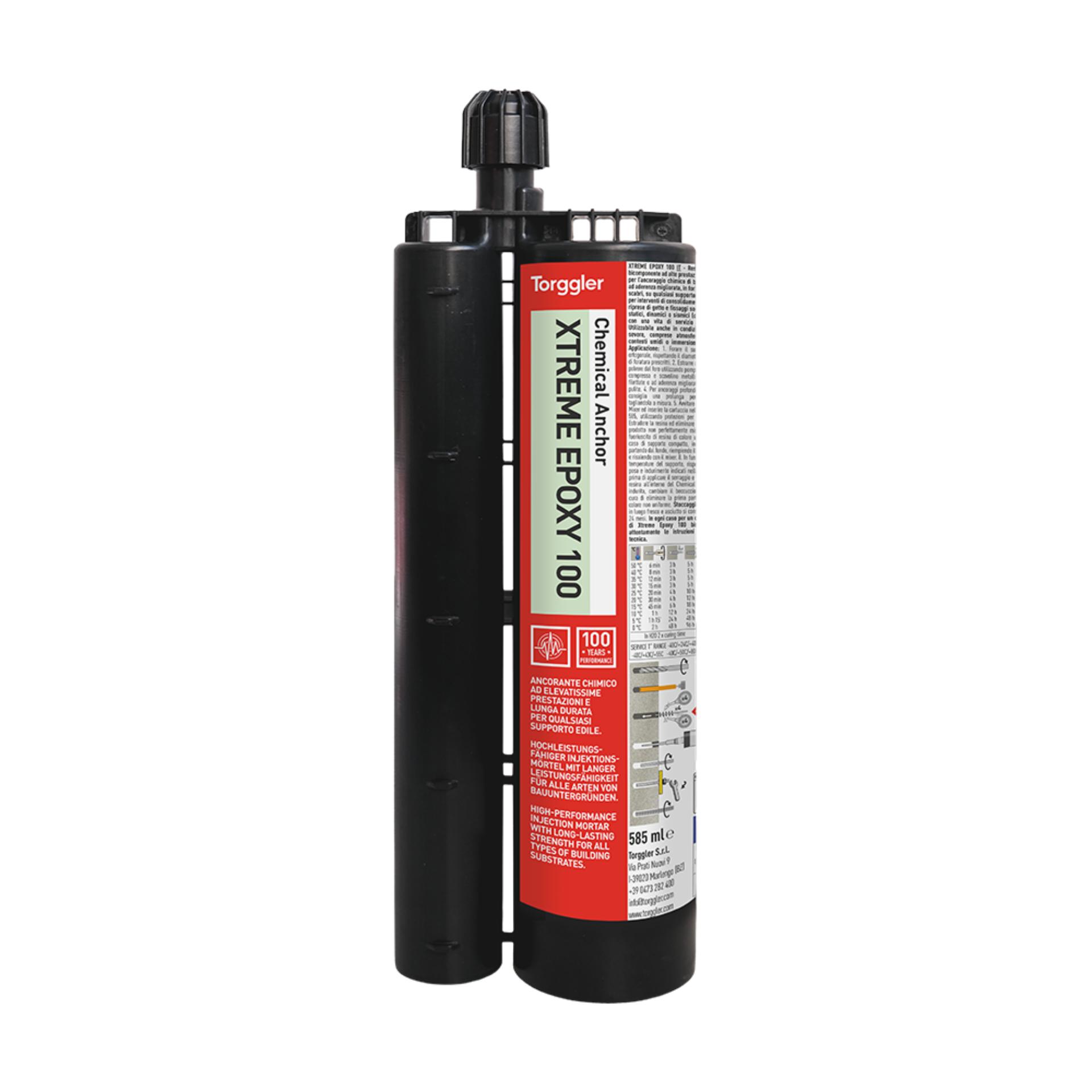
Xtreme Epoxy 100
High-performance epoxy chemical anchor for structural fastening of heavy loads, including in seismic zones, with a service life of 100 years.
High-performance epoxy chemical anchor for structural fastening of heavy loads, including in seismic zones, with a service life of 100 years.




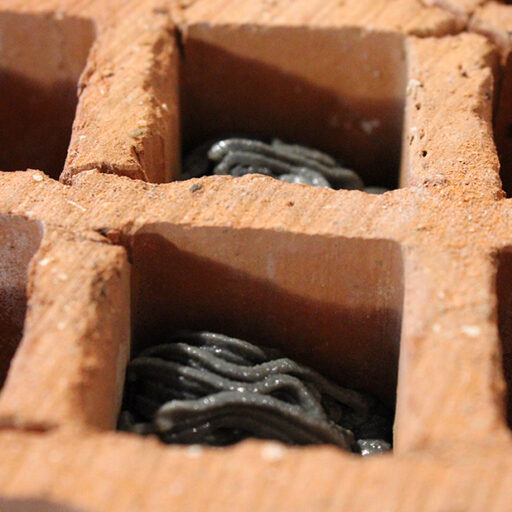
Discover more
A two-component, pure epoxy chemical anchor, styrene-free. Product certified under the European Technical Assessment (ETA) for anchoring in concrete in accordance with EAD 330499-01-0601 and EAD 330087-01-0601, in accordance with the Construction Products Regulation 305/2011. Also suitable for fixing to masonry and timber and for consolidation works. Service life of 100 years compared to the standard value of 50 years, ideal for major projects. Seismic classification C2 for threaded bars and for post-installed connections of bars with improved bond. Application is possible overhead thanks to its thixotropic properties. It can also be applied even when the substrates are wet and the hole is flooded, including underwater fixings, without doubling the time required for load-bearing. Thanks to its high bond strength, it can be applied to perfectly smooth holes created by diamond core drilling. Thanks to its slow curing, it can be used for anchors with hole depths of up to 2.5 metres. It nevertheless offers reduced tightening times to increase productivity on site. It can also be used as a repair and filling compound. Environmental qualifications relating to VOC emissions: LEED GOLD and compliant with CAM requirements.
When stored in a dry, sheltered place in its original, unopened packaging, Xtreme Epoxy 100 has a shelf life of at least 14 months.
| Code | Components | Packaging | Packaging size | Barcode |
|---|---|---|---|---|
| 8455 | 2 components | cartridge | 12x585 ml |

|
When used in conjunction with threaded rods or high-grip rods, it is suitable for a wide range of applications involving the securing of heavy loads or where, due to extreme temperatures (<0 °C or >+30 °C), other types of anchors cannot be used, even in smooth drilled holes. As it contains no styrene, it is also suitable for use indoors.
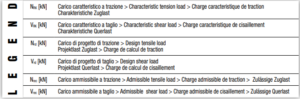
APPLICATIONS IN ACCORDANCE WITH THE EC-2 ANCHORAGE THEORY:
Load data for maximum effective anchorage depth with cracked concrete (Option 1) C20/25 and 8.8 grade steel threaded bar:
| Bar | Effective Anchorage Depth | Characteristic Tensile Load | Characteristic Shear Load | Design Tensile Load | Design Shear Load | Permissible Tensile Load | Permissible Shear Load |
|---|---|---|---|---|---|---|---|
| d [mm] | hef max [mm] | NRk [kN] | VRk [kN] | NRd [kN] | VRd [kN] | NRec [kN] | VRec [kN] |
| M12 | 240 | 63.3 | 34.0 | 42.2 | 27.2 | 30.1 | 19.4 |
| M16 | 320 | 120.5 | 63.0 | 80.3 | 50.4 | 57.4 | 36.0 |
| M20 | 400 | 175.8 | 98.0 | 117.2 | 78.4 | 83.7 | 56.0 |
| M24 | 480 | 289.2 | 141.0 | 192.8 | 112.8 | 137.7 | 81.0 |
| M27 | 540 | 320.3 | 184.0 | 213.5 | 147.2 | 152.5 | 105.1 |
| M30 | 600 | 367.2 | 224.0 | 244.8 | 179.9 | 174.9 | 128.0 |
Load data for maximum effective anchorage depth with cracked concrete OPZ.1 C20/25 and Rebar B450C – BST500:
| Bar diameter | Effective Anchorage Depth | Characteristic Tensile Load | Characteristic Shear Load | Design Tensile Load | Design Shear Load | Permissible Tensile Load | Permissible Shear Load |
|---|---|---|---|---|---|---|---|
| d [mm] | hef Max [mm] | NRk [kN] | VRk [kN] | NRd [kN] | VRd [kN] | NRec [kN] | VRec [kN] |
| Ø8 | 160 | 27.6 | 13.8 | 19.7 | 9.2 | 14.1 | 6.6 |
| Ø10 | 200 | 43.2 | 21.6 | 30.9 | 14.4 | 22.0 | 10.3 |
| Ø12 | 240 | 62.2 | 31.1 | 44.4 | 20.7 | 31.7 | 14.8 |
| Ø14 | 280 | 84.7 | 42.3 | 60.5 | 28.2 | 43.2 | 20.2 |
| Ø16 | 320 | 110.6 | 55.3 | 79.0 | 36.9 | 56.4 | 26.3 |
| Ø18 | 360 | 140.0 | 70.0 | 100.0 | 46.7 | 71.4 | 33.3 |
| Ø20 | 400 | 172.8 | 86.4 | 123.4 | 57.6 | 88.2 | 41.1 |
| Ø22 | 440 | 209.1 | 104.5 | 149.3 | 69.7 | 106.7 | 49.8 |
| Ø25 | 500 | 270.0 | 135.0 | 192.8 | 90.0 | 137.7 | 64.3 |
| Ø28 | 560 | 338.7 | 169.3 | 241.9 | 112.9 | 172.8 | 80.6 |
| Ø30 | 600 | 388.8 | 194.4 | 277.7 | 129.6 | 198.4 | 92.6 |
| Ø32 | 640 | 442.3 | 221.2 | 316.0 | 147.4 | 225.7 | 105.3 |
| Ø40 | 800 | 653.5 | 345.6 | 435.6 | 230.4 | 311.2 | 164.6 |
POST-INSTALLED CONNECTIONS OF REINFORCING BARS WITH IMPROVED ADHESION IN ACCORDANCE WITH REBAR EC-2:
Load data for concrete and Rebar B450C – BST500:
| Bar diameter | BOND STRESS fbd [N/mm²] |
||||||||
|---|---|---|---|---|---|---|---|---|---|
| (d) | C 12/15 | C 16/20 | C 20/25 | C 25/30 | C 30/37 | C 35/45 | C 40/50 | C 45/55 | C 50/60 |
| Ø 8 mm | 1.6 | 2.0 | 2.3 | 2.7 | 3.0 | 3.4 | 3.7 | 4.0 | 4.3 |
| Ø 10 mm | 1.6 | 2.0 | 2.3 | 2.7 | 3.0 | 3.4 | 3.7 | 4.0 | 4.3 |
| Ø 12 mm | 1.6 | 2.0 | 2.3 | 2.7 | 3.0 | 3.4 | 3.7 | 4.0 | 4.3 |
| Ø 14 mm | 1.6 | 2.0 | 2.3 | 2.7 | 3.0 | 3.4 | 3.7 | 4.0 | 4.3 |
| Ø 16 mm | 1.6 | 2.0 | 2.3 | 2.7 | 3.0 | 3.4 | 3.7 | 4.0 | 4.3 |
| Ø 20 mm | 1.6 | 2.0 | 2.3 | 2.7 | 3.0 | 3.4 | 3.7 | 4.0 | 4.3 |
| Ø 25 mm | 1.6 | 2.0 | 2.3 | 2.7 | 3.0 | 3.4 | 3.7 | 4.0 | 4.3 |
| Ø 26 mm | 1.6 | 2.0 | 2.3 | 2.7 | 3.0 | 3.4 | 3.7 | 4.0 | 4.3 |
| Ø 28 mm | 1.6 | 2.0 | 2.3 | 2.7 | 3.0 | 3.4 | 3.7 | 4.0 | 4.0 |
| Ø 30 mm | 1.6 | 2.0 | 2.3 | 2.7 | 3.0 | 3.4 | 3.7 | 4.0 | 4.0 |
| Ø 32 mm | 1.6 | 2.0 | 2.3 | 2.7 | 3.0 | 3.4 | 3.7 | 4.0 | 4.0 |
| Ø 36 mm | 1.5 | 1.9 | 2.2 | 2.6 | 2.9 | 3.3 | 3.6 | 3.6 | 3.6 |
| Ø 40 mm | 1.5 | 1.8 | 2.1 | 2.5 | 2.8 | 3.1 | 3.1 | 3.1 | 3.1 |
LOAD DATA FOR FASTENING TO WOOD AND MASONRY:
| Material | Bar type | Bar Ø | Permissible tensile load | Permissible shear load |
|---|---|---|---|---|
| (d) | NR,c [kN] | VR,c [kN] | ||
| Solid brick | A2-70 / A4-70 / ≥ 4.6 | M8 – Ø8 | 2.0 | 3.0 |
| A2-70 / A4-70 / ≥ 4.6 | M10 – Ø10 | 2.6 | 3.4 | |
| A2-70 / A4-70 / ≥ 4.6 | M12 – Ø12 | 2.8 | 3.9 | |
| A2-70 / A4-70 / ≥ 4.6 | M16 – Ø16 | 4.0 | 4.2 | |
| Glued laminated timber | Rebar (*) ≥ 4.6 / A2-70 / A4-70 | M8 – Ø8 | 3.2 | — |
| Rebar (*) ≥ 4.6 / A2-70 / A4-70 | M10 – Ø10 | 4.2 | — | |
| Rebar (*) ≥ 4.6 / A2-70 / A4-70 | M12 – Ø12 | 6.1 | — | |
| Rebar (*) ≥ 4.6 / A2-70 / A4-70 | M16 – Ø16 | 10.7 | — | |
For the intended geometries and installation conditions, in addition to the load values for all installation conditions specified in the guidelines, please consult ETA – 22/0469 and ETA – 22/0468.
Siehe Technisches Datenblatt.
Contact our team for personalized support and product guidance.