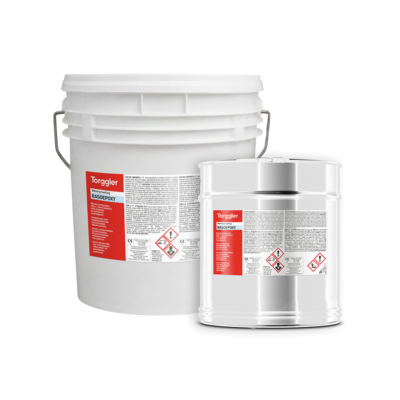
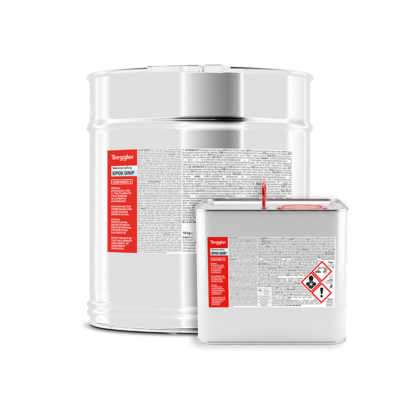
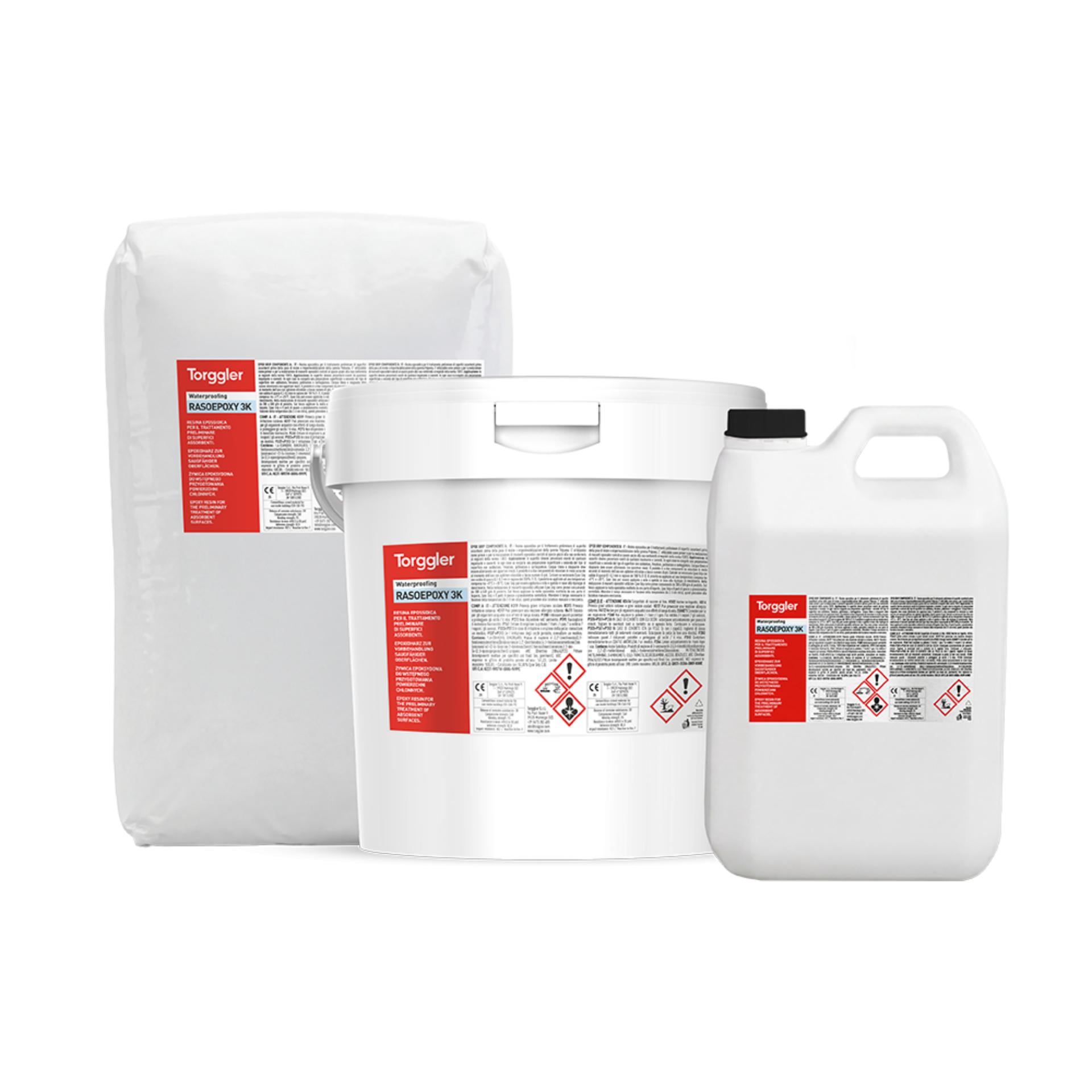
Rasoepoxy 3K
A three-component, thixotropic epoxy-cementitious mortar, suitable for protecting and levelling both vertical and horizontal surfaces exposed to moisture and requiring good chemical resistance and high abrasion resistance.

A three-component, thixotropic epoxy-cementitious mortar, suitable for protecting and levelling both vertical and horizontal surfaces exposed to moisture and requiring good chemical resistance and high abrasion resistance.


Discover more
Substrate preparation
Substrate preparation is essential; therefore, the surface to be treated must be free from any contaminants, dry, sound, and have a tensile strength of at least 1.5 MPa. In all cases, the floor surface must be prepared by sandblasting, milling, shot-blasting, grinding or sanding, depending on the type of surface. Any free-standing or standing water originating from the substrate, previous washing operations or weather conditions must be removed or dried using appropriate methods.
Product preparation
Three-component product to be mixed thoroughly before use with a low-speed mechanical propeller mixer, proceeding as follows:
1. Mix component B with component A for a few minutes until a homogeneous, lump-free mass of uniform colour is obtained;
2. Add component C whilst stirring and mix until completely homogenised.
Depending on the intended use and the problems to be solved, the product can be used as is, diluted in various ways with water, or loaded with 0.06–0.25 mm quartz. Dilution and the addition of fillers must be carried out after the two components have been thoroughly mixed, homogenising with the same mixer. The product must be applied at a temperature between +5 °C and +45 °C.
Application
Rasoepoxy 3K must be applied as appropriate using a brush, trowel or airless spray. In the latter case, use 45/60:1 piston pumps with tungsten carbide nozzles adjustable from 0.025–0.029 inches and pressures of around 250 bar, using the product diluted with 5–10% water.
No surface treated with Rasoepoxy 3K must be covered for at least 48 hours under ideal conditions (+20 °C, 60% RH) or, in any case, before it has been confirmed to be completely dry, as verified with a hygrometer. In the event of poor substrate or environmental humidity conditions, waiting times of up to 6 days are recommended, along with the application of two or more coats of the product until complete drying is achieved, prior to any further finishing with coatings. The hardened and dry layer of ‘Rasoepoxy 3K’ can be directly overlaid with any type of epoxy coating, whether solvent-based or solvent-free.
When kept in its original sealed packaging, stored in a dry, sheltered place at a temperature between +5 °C and +35 °C, the product has a shelf life of 12 months. Keep away from frost.
Do not apply ‘Rasoepoxy 3K’ directly to:
Do not apply ‘Rasoepoxy 3K’ to cracks that may move, as the product is rigid and may therefore crack.
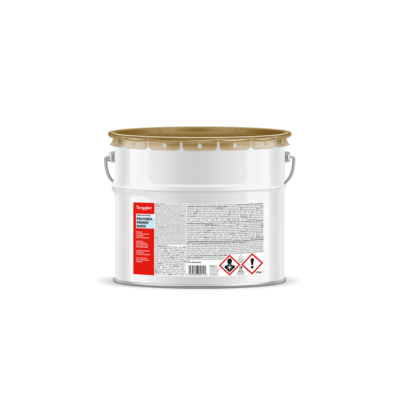
| Code | Components | Packaging size | Barcode |
|---|---|---|---|
| 8478 * | 3 components | 16kg |

|
| Parameter | Value (Neutral or White) | Reference standard |
|---|---|---|
| Colour | Neutral or white | – |
| Density | Neutral: 1.66 ± 0.05 kg/lWhite: 1.60 ± 0.05 kg/l | EN ISO 2811-1 |
| Viscosity at +20 °C | Neutral: 12,000 ± 2,000 mPa·sWhite: 15,000 ± 3,000 mPa·s | EN ISO 2555 |
| Pot life at +22 °C | 40 minutes | EN ISO 9514 |
| Theoretical thickness | 200 µm | – |
| Adhesion strength (direct pull) | > 3.0 MPa | EN 1542 |
| Resistance to reverse hydrostatic pressure (250 kPa) | No water penetration | UNI 8298-8 |
| Compatibility with wet concrete | > 3.5 MPa | EN 13578 |
| Carbon dioxide permeability | sD > 50 m | EN 1062-6 |
| Water vapour permeability | sD < 5 m | EN ISO 7783-2 |
| Capillary absorption and water permeability | w < 0.1 kg/m² × h⁰.⁵ | EN 1062-3 |
Theoretical consumption: 500 g/m² per mm of thickness.
Contact our team for personalized support and product guidance.